
According to Greek mythology, the Greeks spent ten years attempting to conquer the fortified city of Troy after Paris, Troy’s prince, abducted Helen, the wife of Menelaus, King of Sparta. Despite prolonged siege and repeated attempts to breach the city’s defenses, the Greeks failed to penetrate its walls. It was only when they adopted an unconventional strategy—presenting a massive wooden horse as a divine offering—that they succeeded. The Trojans, believing the horse to be a gift, brought it inside their city. That single decision enabled Greek soldiers hidden within to emerge at night, opening the gates from within and bringing about the city’s rapid destruction.
A city that withstood a decade of external assault collapsed in a single night, not because its defenses were weak, but because its perception of trust was flawed.
The Trojan Horse has long served as a metaphor in cybersecurity. Yet, the full lesson of the story remains insufficiently internalized in modern defense strategies.
For over a decade, organizations have invested heavily in identifying and stopping attackers at the perimeter. Security teams are trained to detect phishing campaigns, exploit attempts against public-facing applications, and unauthorized access attempts. In essence, they are trained to recognize the moment when the “Greek army” attempts to breach the gates.
Supply chain attacks fundamentally challenge the traditional security model. Instead of breaking through defenses, attackers exploit trusted relationships to gain access. High-profile incidents such as SolarWinds and Kaseya demonstrated this paradigm with striking clarity. In these cases, attackers compromised software providers and inserted malicious code into legitimate updates. Organizations then deployed these updates themselves, effectively introducing attackers into their own environments without triggering traditional security alerts.
There was no obvious breach. No firewall was bypassed. No malicious payload was downloaded from an unknown source. The activity appeared entirely legitimate.
This is precisely what makes supply chain attacks so dangerous.
We define this challenge as the Implicit Trust Exploitation Problem, a condition in which attackers operate entirely within legitimate and trusted boundaries, rendering traditional detection models ineffective. This is not a vulnerability. It is a design reality.

The scale of this problem is growing rapidly. According to the IBM X-Force Threat Intelligence Index 2026, there has been a nearly fourfold increase in large-scale supply chain or third-party compromises since 2020 , driven primarily by attackers exploiting trusted relationships, CI/CD pipelines, and SaaS integrations. Additional research shows that attackers increasingly prefer abusing legitimate credentials and trusted access paths rather than exploiting vulnerabilities directly.
The root cause is structural. No modern organization operates independently. Every organization relies on a complex ecosystem of vendors, cloud providers, managed service providers, open-source libraries, and hardware manufacturers. Each dependency introduces an implicit trust relationship and with it, a potential attack vector.
These risks manifest across multiple layers of the modern digital ecosystem, from software supply chains to managed services and hardware dependencies.
Open-source software exemplifies this risk. Today, modern applications are heavily dependent on open-source components, often comprising a significant portion of the codebase. Academic research has documented malicious packages distributed through repositories such as npm, PyPI, and RubyGems, specifically designed to compromise downstream users. In practice, attackers embed malicious logic into seemingly legitimate libraries which, once installed, immediately execute within trusted environments. This creates an attack surface that is both vast and continuously evolving.
Managed Service Providers introduce an additional layer of exposure. Organizations frequently rely on MSPs for IT management, monitoring, and security operations. While this improves operational efficiency, it also creates a powerful attack vector. If an MSP is compromised, attackers may inherit legitimate access into multiple client environments simultaneously. From a detection standpoint, this activity is extremely difficult to identify, as it originates from known IP addresses and uses valid credentials.
In many cases, organizations are not breached; they are used.
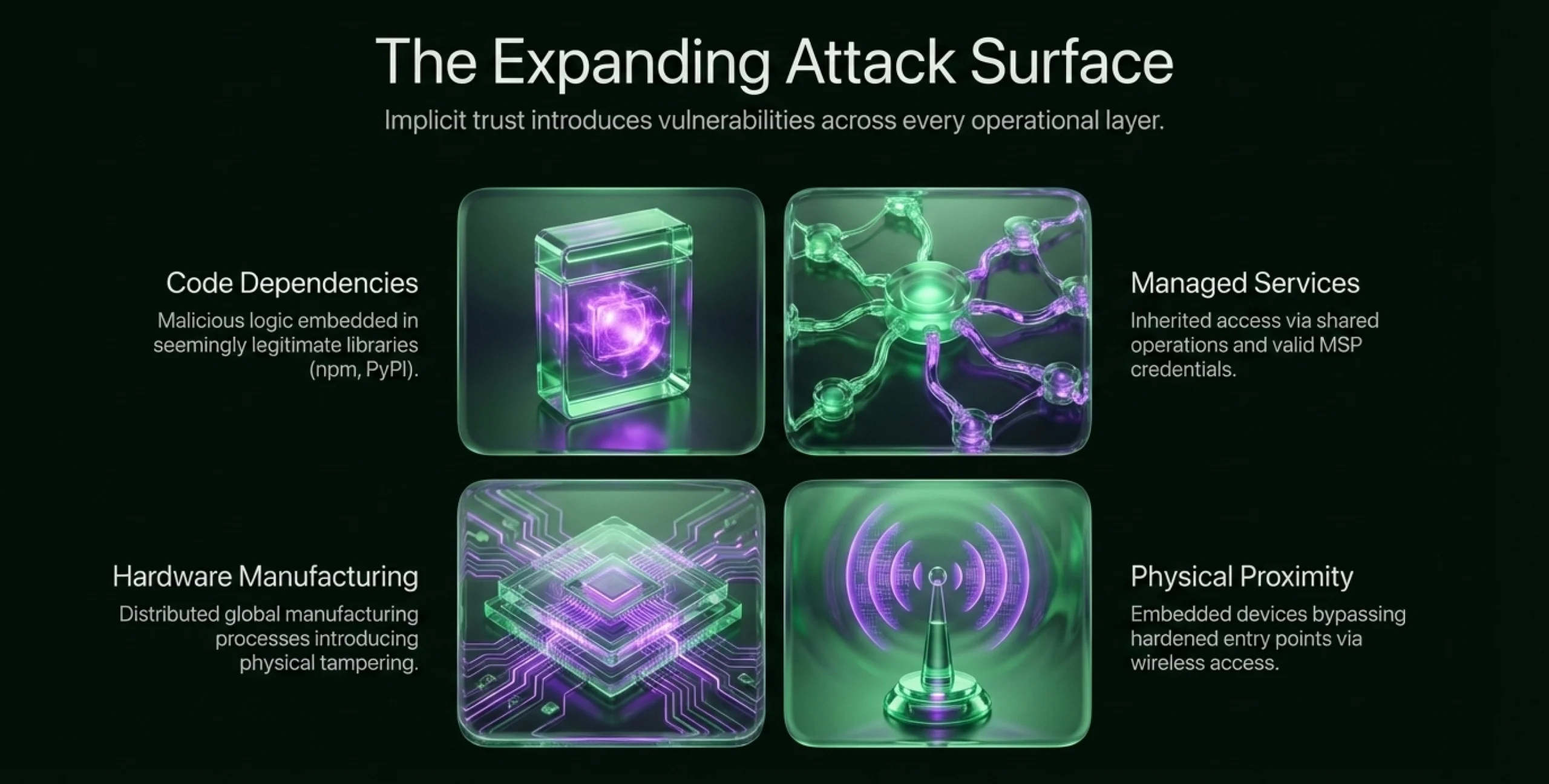
Supply chain risks are not limited to software. Hardware supply chains present equally significant concerns. The widely discussed Supermicro case raised questions about potential hardware-level tampering within globally distributed manufacturing processes. While some aspects remain disputed, the broader geopolitical implications are clear: control over hardware manufacturing can translate into strategic cyber advantage. This concern has led to explicit regulatory action. In the United States, the National Defense Authorization Act (NDAA) Section 889 prohibits the use of certain Chinese telecommunications and surveillance equipment in federal systems. Similarly, the Federal Communications Commission has enforced restrictions under the Secure and Trusted Communications Networks Act. In the United Kingdom, the Telecommunications (Security) Act 2021 mandates strict security controls and the phased removal of high-risk vendors from critical infrastructure.
These measures reflect a broader recognition: supply chain security is no longer purely a technical issue; it is a strategic and geopolitical concern.
There are also emerging cases demonstrating how attackers bypass traditional entry points entirely. In multiple documented incidents, cybercriminal groups have leveraged physical proximity combined with wireless attack techniques using rogue access points, embedded devices such as Raspberry Pi, and even aerial platforms to gain initial access to corporate networks without triggering perimeter defenses. While these attacks vary in execution, they share a common principle: bypassing hardened entry points by exploiting alternative, less monitored access paths.
The core challenge, therefore, is not merely detecting external intrusion, but identifying activity that blends seamlessly into expected operational behaviour.
A trusted vendor accessing unusual datasets, a network management tool performing unexpected actions, or a routine software update behaving slightly differently than expected. These are the subtle indicators that define modern supply chain attacks.
The defender’s task is no longer distinguishing between “malicious” and “benign” but identifying deviations within trusted behaviour at scale, under conditions of noise, ambiguity, and operational pressure.
Addressing this challenge requires a fundamental shift in both technology and training. Zero Trust Architecture reduces reliance on implicit trust, while behavioural analytics and AI-driven models help define and detect deviations from normal activity. However, technology alone is insufficient. The human element remains critical.
Defenders must be trained to operate in environments where there is no clear alert, no obvious malicious signature, and no predefined playbook. They must be able to correlate fragmented signals, build hypotheses, and reconstruct the attacker’s path within the network. These are not skills that can be developed through traditional alert-driven training environments.
At Cympire, recent experience has highlighted the importance of this transition. Modern cyber training must evolve beyond purely technical exercises and incorporate operational decision-making under uncertainty. Teams are required not only to analyse technical artifacts, but also to prioritize actions, allocate responsibilities, and connect disparate findings into a coherent narrative.
Initial deployments of such environments have revealed a consistent pattern: even highly skilled technical professionals often struggle to reconstruct the full kill chain of an attack in real time. They can identify individual indicators but not always connect them. They can detect anomalies but not always explain their significance within the broader operational context.
Modern supply chain attacks operate on the same principle. They do not break the gates; they are invited inside.
Organizations that continue to focus solely on external threats risk overlooking the most dangerous attacks, the ones that already exist within their trusted environment.
In 2026, the most dangerous attack is not the one you block.
It is the one you never thought to question.